





Buffing is the last operation before a part is inspected, packed, and judged. Everything upstream — the cut, the weld, the grind, the successive abrasive stages — is preparation. The buff determines what the customer actually sees. And yet buffing wheels are routinely bought the way office supplies are bought: by diameter, by the dozen, from whoever quoted lowest.
That habit persists because a buffing wheel looks simple. It is cloth, stitched, with a hole in the middle. There is no obvious technology in it. But two wheels of identical diameter and ply count can produce visibly different finishes on the same machine with the same compound, wear at different rates, run with different vibration signatures, and leave one line struggling to hit a specification the other clears comfortably.
The difference lies in cloth quality, cut direction, stitch architecture, centre construction, balance, and the consistency with which all of these are reproduced batch after batch. Those are manufacturing variables, controlled — or not — inside the factory. This checklist is written for buyers evaluating specialized buffing wheel manufacturers: fabricators finishing stainless vessels and architectural panels, contract polishers, automotive and hardware producers, distributors building a range, and industrial brands developing private-label consumables.
Why Buffing Consumables Deserve More Scrutiny Than They Get
Three characteristics make buffing wheels a higher-stakes purchase than their unit price suggests.
Export-Standard Cutting Wheel Manufacturer
The first is that finish defects are expensive and late. A scratch pattern, a hazy patch, or a wavy reflection on a mirror-polished panel is discovered at final inspection, after all the value has been added. Rework means going back several abrasive stages, not just re-buffing. On large architectural or sanitary components, a single rejected part can consume more labour than a year’s supply of buffs.
The second is that buffing is labour-intensive. Consumable cost is almost always a minor line next to the operator hours spent at the wheel. A buff that reaches the target finish in fewer passes, or holds its face longer between rakes, changes the labour equation far more than its price does. Buying the cheapest wheel and paying for extra passes is a poor trade that rarely appears in a procurement report because the two costs sit in different accounts.
The third is that buffing wheels are rotating equipment. They run at high peripheral speeds, they are handled at arm’s length, and an unbalanced or poorly constructed wheel transmits vibration directly into the operator’s hands and wrists. Cloth wheels do not fail the way bonded abrasives do, but they can throw sections, catch workpieces, and generate significant hand-arm vibration exposure over a shift.
None of this is visible in a catalogue listing.
Checkpoint One: Do They Ask About Your Substrate and Finish Specification?
The first thing to evaluate about a supplier is the quality of their questions. A serious partner will not quote until they understand what you are finishing and to what standard.
Substrate drives nearly everything. Austenitic stainless steel, aluminium, brass, zinc die castings, carbon steel, and plated surfaces each respond differently to the same wheel and compound. Aluminium loads a buff quickly and generates heat that can smear rather than cut. Brass polishes readily but discolours if overheated. Stainless demands sustained pressure and generates the most heat of the common substrates. A wheel and compound pairing optimised for brass will disappoint badly on 316 stainless.
Finish specification matters just as much. A satin or brushed finish, a bright satin, a semi-bright, and a true mirror finish each require different stages and different wheel constructions. Where a specification references a numerical roughness target or an industry finish designation, that number should shape the recommendation.
Part geometry then determines the physical form of the wheel. Flat panels tolerate large, firm wheels. Contoured castings, tube welds, corners, and internal radii need softer, more conformable constructions or specialised profiles. A buffing wheel that cannot reach the geometry is useless regardless of its quality.
A supplier who quotes a diameter and a price without asking about any of this is selling cloth. Move on.
Checkpoint Two: Cloth Provenance and Grade
Cloth is the raw material, and it is where cost is most often removed invisibly. Buffing cloth is specified by thread count, fibre content, weave, and treatment. Higher thread counts produce a denser, harder-acting face that cuts faster and holds its shape under pressure. Lower counts give a softer, more forgiving face suited to colouring and final gloss work. Fibre content matters because pure cotton behaves differently from cotton-polyester blends, with the blends generally resisting heat differently and holding compound differently.
Mill treatment is a further variable. Some cloth is chemically treated to stiffen it and increase its cutting aggression. Untreated cloth stays softer. Bleached and unbleached cloth differ in both appearance and, more subtly, in how cleanly they release compound residue.
The recurring cost-reduction tactic among low-tier producers is to substitute reclaimed or off-grade cloth — recycled mill ends, seconds, or fabric with inconsistent thread count across a roll. Wheels made from mixed-grade cloth behave inconsistently across the face and between wheels from the same carton.
Ask a prospective supplier which cloth specifications they use for each product in the range, whether they buy first-quality mill goods or reclaimed material, and how incoming cloth is verified. A manufacturer with real control over its inputs will answer with specifications. One that cannot say where its cloth comes from cannot promise consistency.
Checkpoint Three: Cut Direction and Construction
Bias-cut construction, where discs are cut at an angle to the weave, resists fraying and holds its shape as the wheel wears. Straight-cut construction is cheaper to produce and yields more discs per metre of cloth, but it frays and sheds more readily. The economics of straight cutting are attractive to a manufacturer and invisible to a buyer inspecting a new wheel.
Stitch architecture sets the hardness of the working face. Spiral sewn wheels, where stitching runs in a continuous spiral from centre to edge, produce a firm face suited to cutting operations, with stitch spacing determining how firm. Tighter spacing gives a harder, more aggressive wheel; wider spacing gives more flexibility. Concentric sewn wheels use rings of stitching for a different stiffness profile. Loose or full-disc wheels, with stitching only near the centre, give a soft, highly conformable face used for colouring and final gloss.
Airway or ventilated constructions introduce airflow through the wheel, running cooler on operations where heat build-up compromises the finish or the substrate. Sisal wheels, using coarse natural fibre, provide the aggressive early cut on heavily worked surfaces before cotton stages take over. Canvas and felt serve their own niches, felt in particular where a firm, non-conforming face is needed for flat surfaces and edge definition.
Ply count and packing density determine face hardness and wheel life. A wheel described as sixteen ply might contain sixteen plies of dense first-quality cloth or sixteen plies of thin, low-count material, and the two will behave nothing alike.
When comparing quotations, insist that construction be specified fully — cut direction, cloth grade, ply count, stitch type and spacing, and finished face width. Otherwise you are comparing prices attached to different products.
Checkpoint Four: Centre Construction, Balance, and Concentricity
A plain-hole wheel relies entirely on flanges for support and can distort or elongate over time, particularly under heat. Reinforced centres — leather, plastic, or clinched metal — keep the bore round, distribute load, and stop the wheel walking on the spindle. For screw-on applications on tapered spindles, thread quality and alignment determine whether the wheel runs true.
Balance and concentricity are the practical outcome of centre construction combined with even cloth distribution. An out-of-balance buff at typical operating speeds produces vibration that degrades finish quality, accelerates spindle bearing wear, and exposes the operator to hand-arm vibration. On long shifts this is a genuine health exposure, not a comfort issue. Where a buyer has an obligation to manage vibration exposure, consumable balance is part of that obligation.
Ask how bore tolerance is controlled, what centre reinforcement is used in each product, and whether the manufacturer performs any balance verification on finished wheels. Ask specifically about larger diameters, where imbalance effects scale sharply.
Also confirm the maximum operating speed rating for each construction and diameter, and check it against the no-load speed of every machine the wheel will run on. Cloth wheels have real speed limits, and running above them causes wheels to distort, shed material, and lose their working face.
Checkpoint Five: Compound Compatibility and Contamination Control
A buffing wheel is half of a system. The compound is the other half, and manufacturers who understand both give better recommendations than those who sell only cloth.
Compound selection follows the substrate and the stage. Coarser cutting compounds paired with sisal or firm spiral-sewn cotton do the heavy work. Intermediate compounds refine. Colouring compounds on soft loose-fold wheels bring up final gloss. Greaseless compounds applied to the wheel face create a different working surface again, used where an abrasive stage is wanted without switching to a coated abrasive.
Compatibility matters because compound binder chemistry interacts with cloth. A binder that is too aggressive glazes the face and stops the wheel cutting. A wheel too soft for a heavy cutting compound simply absorbs it without transferring work to the part.
Contamination control is where this becomes a compliance question rather than a preference. Stainless steel destined for food, beverage, pharmaceutical, sanitary, marine, or architectural service must not pick up ferrous contamination during finishing, because embedded iron initiates pitting and rust staining in service. That requires attention to compound chemistry and to segregation practice in the polishing area.
A parallel issue affects any part that will later be painted, coated, or bonded: silicone contamination. Silicone residues from compounds or from adjacent processes cause paint craters and adhesion failures that are difficult and expensive to trace. Manufacturers supplying automotive and coating-critical sectors should be able to provide silicone-free declarations without hesitation.
Ask which compounds are validated against which wheel constructions, and ask for safety data sheets and any relevant declarations covering ferrous contamination, silicone content, and restricted substances for your destination markets.
Checkpoint Six: Batch Consistency and Process Control
Consistency is worth more than peak performance, particularly for buyers importing across long lead times. A wheel that performs at ninety-five percent of the best available option, in every shipment, beats one that varies unpredictably.
Consistency in buffing wheels comes from controlled cloth sourcing, standardised cutting, controlled ply counts by weight or count verification, calibrated stitching equipment, and consistent centre installation. It also depends on whether production is run by trained staff to a documented method or by whoever is available that week.
Ask how ply count is verified before assembly, how stitch spacing is controlled and checked, what dimensional tolerances apply to diameter and bore, and whether finished wheels are sampled for weight and dimensional conformity. Ask whether batch records exist and how long they are retained, and whether a finished wheel can be traced back to the cloth lot it came from. Traceability is less established in buffing consumables than in bonded abrasives, and a manufacturer that maintains it is signalling a level of process discipline well above the category norm.
Certification is a useful but secondary signal. ISO 9001 indicates a documented quality system. Occupational health and safety and environmental certifications indicate broader management maturity. Verify certificate numbers directly with the issuing body rather than accepting images, and treat certificates as a starting point for questions rather than an answer to them.
Checkpoint Seven: Machine and Automation Compatibility
On a manual stand or pedestal buffer, the operator controls pressure, dwell, and approach angle, compensating instinctively for variation in the wheel. On automated and robotic finishing cells, nothing compensates. The programme applies a fixed contact position with fixed force, and it assumes a predictable wheel diameter and a predictable wear rate. A wheel that wears faster than expected drifts out of the programmed contact envelope, and finish quality falls away before anyone notices.
Automated finishing therefore demands tighter tolerances on outside diameter, tighter balance, and above all a consistent, predictable wear rate so that offset compensation can be scheduled reliably. A supplier accustomed only to manual shops may not understand why you are asking for these things.
Machine rigidity, spindle speed, contact geometry, and available motor power all shape which wheel construction will actually perform. A firm, dense wheel needs power and pressure behind it; on an underpowered machine it will glaze rather than cut. Conversely, a soft wheel on a powerful high-speed spindle can burn and load rapidly.
The right question to ask a prospective supplier is what they know about the machines you run. If the answer is nothing, and they show no interest in finding out, they are guessing.
Checkpoint Eight: Safety, Dust, and Regulatory Obligations
The first is lint and dust accumulation. Buffing sheds fibre continuously, and that lint combines with compound residue and metal fines in extraction systems, on surfaces, and inside booths. It is combustible, and where aluminium, magnesium, or titanium are being finished, the metallic component of the dust raises the risk substantially. Housekeeping discipline, appropriate extraction design, and wet collection where the metals warrant it are all part of running a buffing operation safely. A supplier who raises this with you unprompted is thinking about your operation rather than their invoice.
The second is exposure at the wheel. Correct machine guarding, correct wheel mounting with appropriate flanges, respect for maximum speed ratings, awareness that loose-fold wheels can catch small parts and pull them, and management of hand-arm vibration over a shift are all part of the picture. Documentation and clear marking from the manufacturer support all of it.
On the regulatory side, obligations vary by destination market and typically include safety data sheets for compounds in the required languages, classification and labelling compliance, declarations relating to restricted substances, and accurate customs classification and origin documentation. A manufacturer geared for export handles this routinely. One that has only served a domestic market will treat every request as an exception.
Checkpoint Nine: OEM and Private-Label Capability
A capable OEM partner will develop constructions to your specification rather than only relabelling standard stock. That means agreeing cloth grade, cut direction, ply count, stitch pattern, centre type, diameter, and bore, then recording all of it in a written specification with change control. Formulation or construction changes without notification are a recurring frustration in consumables supply, and the protection against it is contractual.
Checkpoint Nine: OEM and Private-Label Capability
Beyond the product, evaluate artwork and packaging development, minimum order quantities at the SKU level rather than the order level, lead time reliability, and how sample approval is handled before mass production is released. Ask specifically for a pre-production batch made under normal commercial conditions and verify it against your acceptance criteria. Samples are often produced by the best operator with unusual care; production batches are made at production speed, and the difference between them is where most disappointments originate.
Checkpoint Ten: Logistics, Packaging, and Storage
Cotton buffing wheels are bulky and light, which makes freight cost a meaningful share of landed cost and makes packing efficiency worth discussing. Compressed packing reduces volume but must not permanently deform the wheels.
Cloth is also hygroscopic. Sea freight through tropical routes exposes consumables to humidity and thermal cycling, and cotton that arrives damp can develop mildew, odour, and staining that transfers to finished parts. Moisture barriers, appropriate inner packaging, and desiccant where justified are the countermeasures, along with storage guidance for your own warehouse.
Ask how wheels are packed for ocean freight specifically, what the manufacturer recommends for storage conditions and stock rotation, and whether they have handled shipments into your climate before.
Checkpoint Eleven: Technical Support and Failure Analysis
Every finishing programme encounters problems. Finishes drift, new alloys arrive, a batch behaves oddly, an automated cell starts producing marginal parts. What matters is the response.
Ask a prospective partner what happens when a customer reports a finish problem. Who investigates? Do they have engineers who will look at photographs of the defect and the part, ask about compound, speed, pressure, and preceding stages, and reason through it? Or does the process consist of shipping a replacement carton?
Ask whether they will support process development — recommending stage sequences, wheel and compound pairings, and speeds for a new part or a new alloy. Ask whether they provide training material for operators, since technique variation is one of the largest sources of finish inconsistency in any buffing operation.
The distinction between a vendor and a technical partner shows up here more clearly than anywhere else in the evaluation.
How to Test Candidates Properly
Structured comparison eliminates most of the noise in consumables selection.
Fix everything except the wheel. Same parts, same substrate and surface condition entering the operation, same machine and speed, same compound, same operator, same preceding stages. Then measure what actually matters: the number of parts finished to specification per wheel, the time per part, how the wheel’s face condition holds up and how often it needs raking, the consistency of the finish across a run, and the reject rate at final inspection. Capture operator feedback on pressure required, heat, vibration, and how much lint the wheel sheds.
Then convert to cost per part rather than cost per wheel, including operator time, wheel change time, and the cost of rework or rejects attributable to finish quality. In labour-intensive finishing this calculation frequently inverts the ranking that unit prices suggested.
Finally, do not stop at the sample stage. Re-run the same test against the first production batch before committing the full programme, and periodically thereafter. Gradual drift is far more common in consumables than sudden failure, and only repeated measurement detects it.
Signals That Should Give You Pause
A quotation given without questions about substrate, finish specification, part geometry, or machine is the clearest warning sign available. Reluctance to specify cloth grade, cut direction, or stitch spacing in writing is another, because vagueness in specification is what makes substitution possible later. Inability to name the factory, or evasiveness about whether the company owns it, matters because a trading intermediary cannot control what it does not operate.
Be equally cautious where safety and compliance documentation is treated as an unusual request, where no declaration can be produced regarding ferrous or silicone contamination for applications that require it, and where the answer to a quality complaint is a replacement carton rather than an investigation. Finally, a supplier who dismisses questions about balance, bore tolerance, or wear consistency as over-engineering is telling you they have never supplied an automated finishing cell.
Why Global Buyers Work with Dai Nhan Machinery
Dai Nhan Machinery is Vietnam’s direct manufacturer of industrial belt grinders, polishing machines, and surface finishing systems, based in Cu Chi with 100 percent of our CNC engineering held in-house. We are not a trading company, and that shapes what we can offer buyers working through a consumables evaluation: direct access to engineers who understand the machines, the abrasive and buffing stages, and the interaction between them.
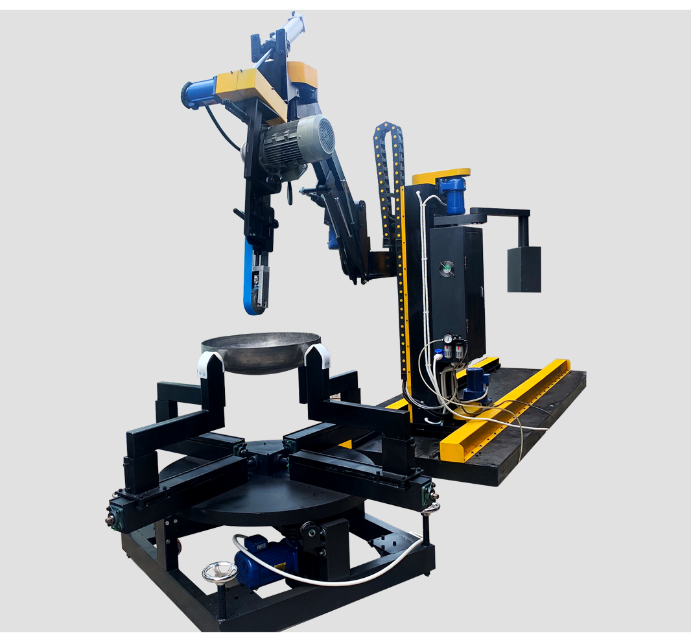
Because we build the equipment, we see finishing as a system rather than a shopping list. Our tank and vessel grinders producing sanitary finishes, our tube and pipe polishing systems, our dual-station stand grinders and heavy deburring stations each impose different demands on consumables, and the correct wheel specification depends on the machine, the alloy, the geometry, and the finish target together. Specifications written without that context routinely underperform in practice, whatever the datasheet claims.
For buyers building OEM or ODM ranges, or restructuring supply chains toward diversified manufacturing origins with export-standard documentation practice, we work as an engineering partner: evaluating the application first, then recommending equipment and consumable specifications built around it. We expect to be audited, and we welcome the kind of questions set out above.
Conclusion
Buffing wheels reward scrutiny precisely because so few buyers apply any. The variables that determine whether a wheel hits your finish specification in three passes or five — cloth grade and provenance, bias versus straight cut, stitch architecture and ply density, centre construction, balance, and batch-to-batch consistency — are all invisible in a finished product and all controlled in the factory.
The buyers who get the most from specialized buffing wheel manufacturers are the ones who evaluate on process rather than price: who ask where the cloth comes from, how ply count and stitch spacing are verified, what tolerances apply to bore and diameter, which compounds are validated against which constructions, and what happens when something goes wrong. Then they test under controlled conditions, calculate cost per part rather than cost per wheel, and verify a production batch before committing.
Do that, and the buffing wheel stops being a commodity line on a purchase order and becomes what it actually is: the component that determines what your customer sees.
Partner with Dai Nhan Machinery
If you are specifying polishing and buffing consumables, developing an OEM or ODM finishing range, or looking for surface finishing equipment engineered around your alloys, geometry, and finish targets, Dai Nhan Machinery is ready to work as your technical partner. Our engineering team evaluates your materials, machines, production objectives, and quality requirements before recommending anything — because a specification written without understanding the application is the most expensive shortcut in industrial procurement. Contact Dai Nhan Machinery to discuss your requirements, request technical documentation, or start a custom OEM engineering project built to your specifications.
Read more: How Grinding Wheel Wholesalers Keep Up with High-Volume Fabricator Demands


BOLA BAG's BLOG YOU MAY ALSO BE INTERESTED IN
Do Belt Sanders Work on Metal? Here’s What We Found
How to Cut Steel With a Grinder: Straight, Safe, and Without Wrecking the Disc
How to Select the Right Industrial Belt Sander for Metal Fabrication